



What London Fashion Week 2026 reveals about the brands winning attention through creators
London Fashion Week has never been short on spectacle. But while the runway sets the agenda for what’s next in fashion, creators increasingly shape what people actually talk about.
So, who won the creator conversation this season?
Companion analyzed creator impressions across more than 30 leading high street and luxury fashion brands during London Fashion Week, tracking more than 250,000 UK-based creator accounts with 10K+ followers.
The result is telling: high street brands generated 58% of all creator impressions, compared with 42% for luxury brands.
And one brand was responsible for almost two-fifths of the entire conversation.
M&S captured almost 40% of creator share of voice
M&S generated 577,400 creator impressions across 14 posts, giving it a 39.2% share of voice across the brands analyzed.
That’s almost twice the share of the next brand, Mulberry, and represents 69.2% of all creator impressions generated by high street fashion retailers.
The interesting part isn’t simply how much attention M&S generated. It’s how it generated it.
The brand used London Fashion Week as a series of creator moments rather than a single event. Its first-ever LFW show, marking 100 years of M&S, gave creators a major cultural moment to cover. But that was supported by behind-the-scenes access, creator-led styling and local activity around the collection.
Stylist and creator @markheyesstylist, for example, brought his audience into the process before the show, sharing BTS access and looks ahead of the main event.
Then the strategy moved beyond London. A collection preview in Glasgow brought nano creators into the story, with content highlighting that 50% of the collection was priced under £50.
The result was a strategy that moved between scale and intimacy: a major fashion moment at the center, with smaller creator experiences making it more accessible and relevant.
A runway show can create a moment. Giving creators different ways into that moment can create a conversation.
High street beat luxury at its own game
Luxury brands still accounted for a significant 42% of creator impressions, but high street retailers collectively took the larger share.
That challenges the assumption that London Fashion Week conversation naturally belongs to luxury.
The brands generating the most creator attention weren’t necessarily the ones with the biggest fashion credentials or most exclusive shows. They were often the brands that could make fashion week feel relevant to more people.
ASOS took 7.1% of total creator share of voice, making it the strongest online-only fashion brand in the analysis. Most of its creator content centered around creators wearing ASOS looks, turning the brand from something to watch into something audiences could actually participate in.
eBay took a different route. Its Endless Runway received relatively limited creator coverage during the event itself, but creator @itssamsalter promoted the show beforehand, encouraging his audience to tune in through the eBay app.
And Nike provides an interesting counterpoint. Its British Vogue collaboration included a Vogue Café pop-up and a community run club event ending at the café. Creator coverage was relatively limited compared with the biggest performers in the dataset.
But that doesn’t necessarily mean the strategy failed.
It appears to have prioritized IRL community-building over maximizing creator impressions. That’s an important distinction when evaluating creator activity: not every creator strategy is designed to win on reach alone.
The luxury story was different
Among luxury brands, Mulberry led the conversation, accounting for 57% of luxury creator share of voice.
The brand benefited from significant cultural momentum around its womenswear relaunch and the news of Christopher Kane’s return, with creators amplifying the story organically.
Barbour followed, driven largely by organic coverage from creators attending London Fashion Week.
Then there was Skims.
A single post from a florist working on the brand’s Regent Street London Fashion Week launch party generated 74,600 impressions – accounting for the entirety of Skims’ creator share of voice in this analysis.
It’s a useful reminder that creator impact doesn’t always come from the biggest names. Sometimes, the creator closest to the story is the one who makes the story travel.
Burberry and Alexander McQueen rounded out the top five luxury brands, with 8.5% and 6.9% of luxury creator share of voice, respectively.
Creator strategy is becoming part of the event strategy
One of the clearest patterns in the data is that the strongest creator strategies didn’t treat creators as an amplification layer added after the main event.
They gave creators something to experience, interpret or bring to their audiences.
That might mean:
- Access before the runway
- Behind-the-scenes content
- A first look at the collection
- Local creator events
- Community experiences
- Personal styling
- A reason to tune into an event
- Or simply being close enough to capture a moment others couldn’t
This changes the role of the creator.
They’re no longer just documenting what happened at fashion week. They’re helping determine how the audience experiences it.
That distinction is particularly important as brands compete for attention in an environment where audiences can see official runway content themselves.
The question is no longer: How do we get creators to post about our show?
It’s closer to: What can creators give their audiences that the brand’s own channels can’t?
Scale gets attention. Access makes it interesting.
M&S’s performance is particularly useful here because its approach combined both.
The runway created a high-profile cultural moment. But the creator strategy didn’t stop at the front row.
Creators were given access to the process, the clothes, the people and the story behind the collection. Smaller creators brought the experience into different communities and locations.
That creates multiple entry points into the same brand story.
And it reflects a wider shift in how creator marketing works around cultural moments.
The biggest opportunity isn’t necessarily to put more creators in the room. It’s to give the right creators more reasons to tell the story.
As Ed East, Global CEO and Founder of Billion Dollar Boy, puts it:
“Audiences aren’t looking for polished, high-production campaign assets – they want behind-the-scenes intimacy and real-time perspective.”
For brands, that means rethinking what “access” looks like.
It isn’t only a front-row seat. It can be access to the making of something, the people behind it, a product before everyone else, a local experience or a perspective that the brand itself can’t authentically provide.
What this means for fashion brands
The London Fashion Week data points to a few lessons for brands planning their next cultural moment.
1. Don’t build the creator strategy around the headline event
The runway, launch or party is only one moment. The strongest strategies build a wider ecosystem around it – before, during and after the event.
2. Think beyond celebrity reach
M&S’s Glasgow activation and Skims’ florist example show how creator relevance can come from proximity, expertise or community rather than follower count alone.
A creator doesn’t need to be the biggest person in the room to have the most interesting story to tell.
3. Give creators something to uncover
Behind-the-scenes access, early looks and personal experiences give creators material to interpret rather than simply reproduce.
That makes the content feel more native to their audience.
4. Measure more than impressions
Creator share of voice tells you who captured attention.
It doesn’t tell you everything about why audiences engaged, whether the content drove action or how effectively a brand built community.
The next question for marketers should be what happened after that attention, and whether it translated into meaningful brand or commercial impact.
5. Build for the audience, not just the event
The best creator activation isn’t necessarily the one that looks most impressive from inside the fashion world.
It’s the one that gives an audience a reason to care.
That might be a £50 piece they can actually buy, a behind-the-scenes look they couldn’t otherwise see, a community event they can join, or a creator explaining the cultural moment in a way that makes sense to them.
London Fashion Week still belongs to fashion. But the conversation increasingly belongs to creators.
And this season, the data suggests the brands making fashion week accessible, participatory and personal were the ones giving creators the most to talk about.
The data at a glance
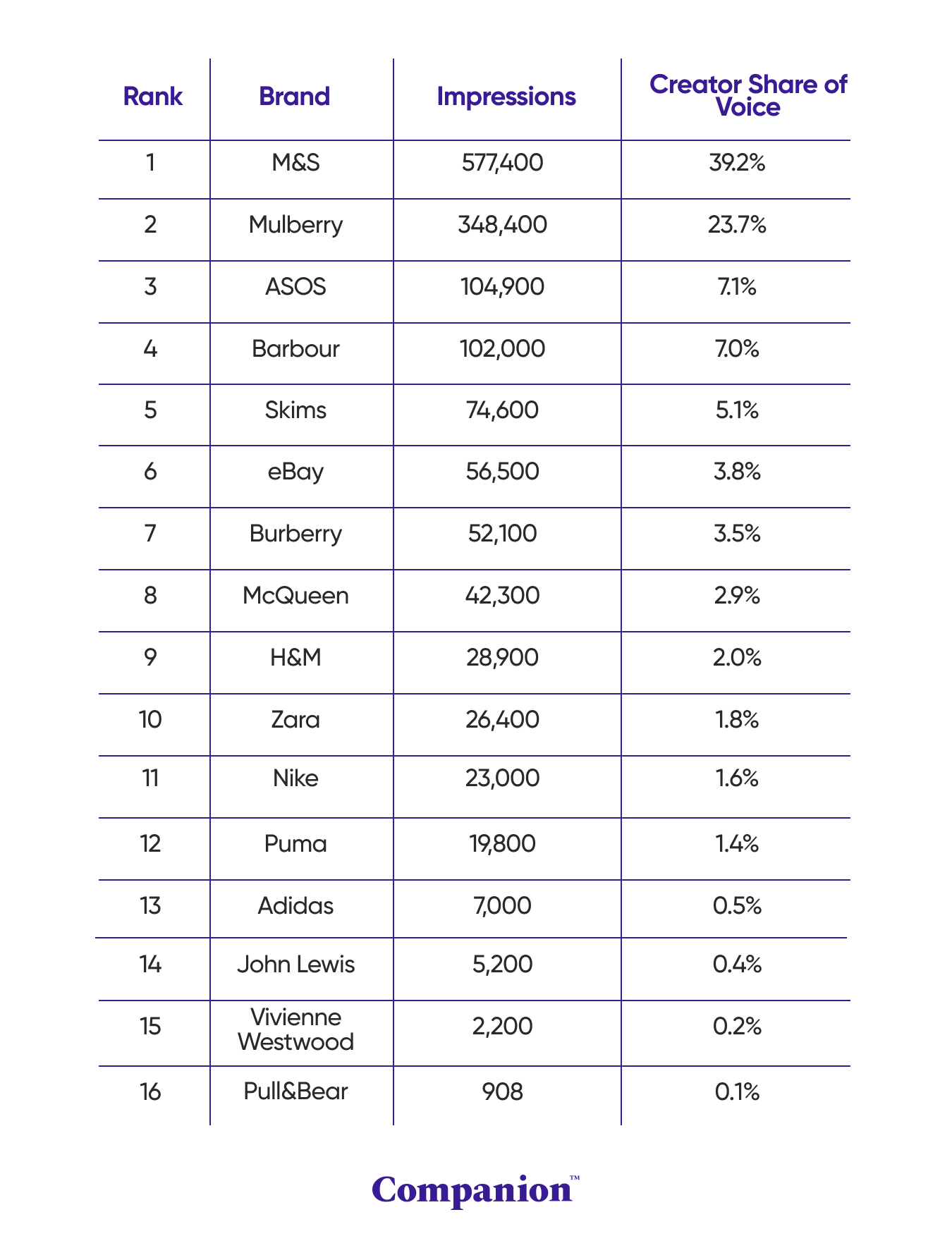
Methodology: Companion analyzed more than 250,000 UK-based creator accounts with a minimum of 10,000 followers, assessing impressions generated between September 17-21, 2026 across more than 30 leading high street and luxury fashion brands mentioning London Fashion Week.
Want to see where your brand stands?
Share of Voice will soon be rolled out across Companion.
The new tool will let you see how your brand is showing up in creator conversations, and how your presence compares with your competitors.
Want an early look? Request a demo to see how your brand performs and be among the first to try Share of Voice when it launches.
Use the insights to understand where you’re winning attention, spot opportunities and build a smarter creator marketing strategy.